Description
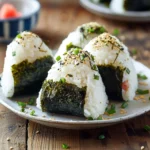
Discover how to make delicious Japanese Onigiri Rice Balls with our easy-to-follow recipe. Learn the art of shaping, filling, and enjoying these popular snacks!
Ingredients
- 2 1/4 cups (540 ml) uncooked Japanese short-grain white rice
- 2 1/2 cups (600 ml) water
- Diamond Crystal kosher salt
- 3 sheets nori (dried laver seaweed)
- 1-2 fillets salmon
- Diamond Crystal kosher salt
- 1 packet katsuobushi (dried bonito flakes) (one packet is typically 3 g or 5 g)
- 1 Tbsp (15 ml) soy sauce
- 1 (5-ounce) can albacore tuna (preferably packed in olive oil)
- 2 Tbsp (30 ml) Japanese Kewpie mayonnaise
- 1/2 Tbsp (8 ml) soy sauce
- 2 umeboshi (Japanese pickled plum)
- 2 sacs spicy salted pollock roe or cod roe (karashi mentaiko)
- shio kombu (prepared)
- furikake (rice seasoning)
Instructions
- To measure 2¼ cups of uncooked Japanese short-grain white rice, fill a US cup measure (a ¾-cup measure is effective for this) or a rice cooker cup with the raw short-grain rice, then level it. Transfer the rice to a large bowl. Repeat this process until you have the necessary amount of rice. Note: 2¼ cups (450 g, equivalent to 3 rice cooker cups) of uncooked Japanese short-grain rice results in 6⅔ cups (990 g) of cooked rice, which is sufficient for 9 onigiri rice balls (each typically weighing 110 g). One cup of cooked rice weighs about 5.3 oz (150 g).
- Proceed to wash and rinse the short-grain white rice and then cook it using a rice cooker, a pot on the stove, an Instant Pot, or a donabe. For detailed instructions on rinsing and cooking the rice, refer to the relevant posts. In this instance, add 2½ cups of water to the drained rice in a rice cooker. Note: The ideal rice-to-water ratio is 1 to 1.1 (or 1.2) for Japanese short-grain white rice. Allow the rice to soak for 20–30 minutes. Refer to the blog post for a comprehensive explanation.
- While the rice is cooking, prepare the fillings. For the Japanese Salted Salmon Filling, place 1–2 fillets of salmon on a baking sheet lined with either aluminum foil (for broiling) or parchment paper (for baking). Sprinkle both sides with Diamond Crystal kosher salt. Note: This is a quick method for salted salmon; for the traditional approach, consult the Japanese Salted Salmon recipe.
- Broil or bake the salmon at 425ºF (218ºC) in a toaster oven or standard oven for 10–20 minutes, ensuring the salmon is well-cooked to achieve a dry and flaky texture. Break the cooked salmon into flakes and set aside.
- For the Okaka Filling, place 1 packet of katsuobushi (dried bonito flakes) in a bowl and add 1 Tbsp of soy sauce. Mix until the katsuobushi is moistened, but not drenched, by the soy sauce.
- To make the Tuna Mayo Filling, put 1 drained (5-ounce) can of albacore tuna (preferably packed in olive oil) in a bowl. Add 2 Tbsp of Japanese Kewpie mayonnaise and ½ Tbsp of soy sauce, then mix to combine.
- For the Umeboshi Filling, remove and discard the seeds from 2 umeboshi (Japanese pickled plums) and place the flesh on a small plate or in a bowl.
- To prepare the Mentaiko Filling, cut 2 sacs of spicy salted pollock roe or cod roe (karashi mentaiko) in half and squeeze out the roe using your hands or a knife. Place the roe on a small plate or in a bowl.
- For the Shio Kombu Filling, place the prepared shio kombu in a bowl for easy access later.
- Gather all ingredients needed to make the onigiri, as well as a bowl of water for your hands. If shaping the onigiri by hand, transfer the freshly cooked rice to a large bowl, baking sheet, or sushi oke (hangiri) and allow it to cool slightly until it’s comfortable to handle. The rice should still be warm when making onigiri.
- Fill another bowl with water. Soak the onigiri mold and lid in the water to prevent the rice from sticking. Remove the mold and drain excess water. Next, sprinkle salt into the moistened mold, which is used for both seasoning and food safety.
- Half-fill the mold with warm rice, ensuring the rice reaches the corners. Add a spoonful of your chosen filling.
- Fill the rest of the mold with more rice, making sure it’s filled to the edges. Sprinkle additional salt on top of the rice.
- Place the lid on top and press down firmly. You should feel a slight resistance; if not, add a bit more rice. Remove the lid, flip the mold over, and press the “button” to release the onigiri onto a parchment-lined baking sheet or plate. Repeat with the remaining rice. Note: Always wet your fingers before handling the onigiri to prevent sticking.
- First, moisten both palms slightly to prevent sticking, then apply some Diamond Crystal kosher salt and spread it across both palms. For salt quantity, dip 2–3 fingers in the kosher salt. If using table salt, apply half the amount due to its stronger saltiness.
- Place a handful (about ⅓ cup, 50 g) of slightly cooled but still warm rice onto your left (non-dominant) hand. Note: Your left hand holds the rice ball and flattens the sides. Always keep it underneath the onigiri. Make a small well (indentation) in the center of the rice and add 1–2 tsp of one type of filling.
- Add more rice (another ⅓ cup, 50 g) to completely cover the filling. Shape the rice with your hands, gently pressing it around the filling to form a ball.
- Slightly bend your right (dominant) hand to form a “mountain” shape and place it on top of the rice. Your right hand shapes the triangle corners of the onigiri, always staying on top of the rice ball. Gently press to create a triangle corner. Note: Ensure your hands are firm enough to keep the onigiri intact but avoid squeezing too tightly. Aim to maintain an airy rice ball. Simultaneously, use the fingers and heel of your left hand to gently press the sides flat.
- Rotate the triangle corner you just formed toward you. Use a single upward motion to barely toss the rice ball in your left hand while your right hand rotates it toward you clockwise (if right-handed). The first corner should now point at you while the tip of the second corner points up. Repeat the “press and rotate” steps to form the second and third triangle corners, then press and rotate 2–3 more times to finish shaping the triangle.
- Turn the rice ball on its side and gently press to flatten one side, then repeat on the other side. Press and rotate one last time. Transfer to a parchment-lined baking sheet or plate. Repeat with the remaining rice.
- If you prefer not to touch the rice with bare hands, use this alternative method, especially when packing onigiri for lunch. Place a piece of plastic wrap in a rice bowl (or any small bowl) and sprinkle some Diamond Crystal kosher salt (used here to preserve the rice longer).
- Add the rice on top. If adding a filling, create a small well (indentation) in the center of the rice and place one type of filling (around 1–2 tsp) inside.
- Then, add more rice to completely cover the filling and sprinkle some salt on top.
- Gather the corners of the plastic wrap and twist it a few times to secure it around the rice.
- Shape the rice into a triangle as described earlier. Optionally, garnish with furikake and/or nori. Always wet your fingers before handling the onigiri to prevent sticking.
- Coat the three sides of the onigiri with furikake (rice seasoning).
- Toast 3 sheets of nori (dried laver seaweed) over an open flame, one by one.
- Then, cut them into thirds, following the lines on the nori sheet.
- Style A: Wrap a strip of nori on one side of the onigiri, trimming the nori into shorter and narrower strips if necessary.
- Enjoy the onigiri while warm or at room temperature.
- Style B: Wrap the onigiri with a piece of nori seaweed. For crispy nori, wait to wrap it until just before eating the onigiri. Store nori in an airtight container or bag to prevent it from becoming stale.
- Place a small amount of each filling on the tip of the onigiri to indicate the filling inside. Enjoy the onigiri warm or at room temperature.
- To pack onigiri for lunch, ensure it stays cool and consume within 6 hours. Onigiri (or any rice dish) becomes hard when refrigerated as cold air dries the rice. Avoid making onigiri too far in advance. If necessary, wrap the onigiri with thick kitchen towels and store in the fridge to keep them cool and safe without getting too cold.
- If your onigiri has dried out, grill it in a frying pan and brush with soy sauce to create Yaki Onigiri.
Notes
- Ensure the salmon is thoroughly cooked and flaky for the best texture in your onigiri.
- Opt for albacore tuna packed in olive oil for added flavor and richness in the Tuna Mayo Filling.
- Wrap onigiri in plastic wrap with a sprinkle of salt to keep them fresh when packing for lunch.